


ChatGPT now processes 2 billion queries every single day. Google AI Overviews appear in one in four searches. Perplexity is growing at hundreds of percent year-over-year. And across all of these platforms, one thing is true: they either recommend your website, or they don't. There's no middle ground.
This guide is the most complete, honest, and practical resource we know of for making your website visible in AI search. It covers everything: from the basics that any marketer can act on today, to the technical optimisations that will compound over time. We'll explain every piece of jargon in plain English. We'll tell you what actually works and what's being oversold. And we'll show you exactly what to do next.
How to use this guide
Start with Part 1 if you're new to this topic.
Already know SEO and want GEO-specific tactics? Jump to Part 3.
Looking for the technical setup? Part 4.
Want fast answers? The FAQ section at the end covers 11 of the most common questions.
What is AI search - and why does it matter for your website
For most of the last 25 years, "being found online" meant one thing: ranking on Google. Someone typed a query, got a list of ten blue links, and clicked through to your website. Your job was to appear as high up that list as possible.
That model is being rewritten in real time.
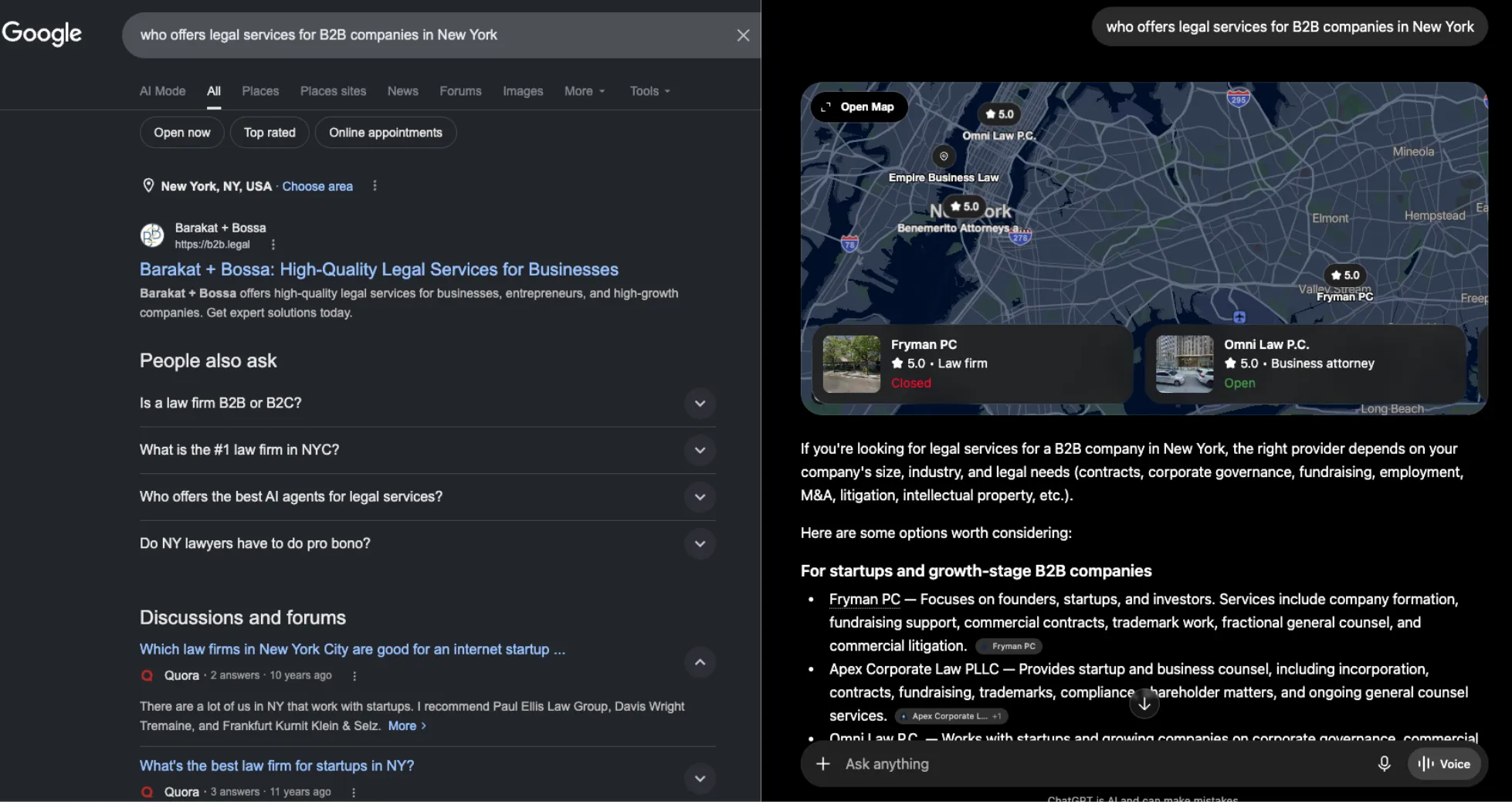
When someone asks ChatGPT "what's the best home building company in Texas" or types "who offers legal services for B2B companies in New York" into Perplexity, they don't get ten links. They get one answer. A synthesised, confident, named recommendation — with maybe two or three cited sources. If your website isn't one of those sources, you don't exist in that conversation.
This is the shift that everything in this guide is designed to address.
Key terms used throughout this guide
| AI Term | What it means in plain English | Used by |
|---|---|---|
| AI Visibility | How well your website shows up and gets recommended in AI-powered tools. The new version of "being found online." | Marketers, business owners |
| GEO | Generative Engine Optimisation. The practice of making your website easy for AI tools to read and recommend. | SEO / marketing teams |
| AIX | AI Experience. The quality of the experience an AI agent has when visiting your website. Poor AIX = AI skips you. | Nicepixels / emerging term |
| AI agent | An automated system that visits websites to collect information on behalf of AI tools like ChatGPT or Perplexity. | Technical teams |
| Citation | When an AI answer references your website as a source. The equivalent of appearing on page 1 of Google — but better. | All audiences |
| AI Overview | Google's AI-generated summary that appears at the top of search results, above the traditional blue links. | All audiences |
| AI Visibility | How well your website shows up and gets recommended in AI-powered tools. The new version of "being found online." | Marketers, business owners |
| GEO | Generative Engine Optimisation. The practice of making your website easy for AI tools to read and recommend. | SEO / marketing teams |
The numbers: how much traffic is AI search actually sending?
Before getting into tactics, let's ground this in real data. The landscape changed significantly in mid-2026.
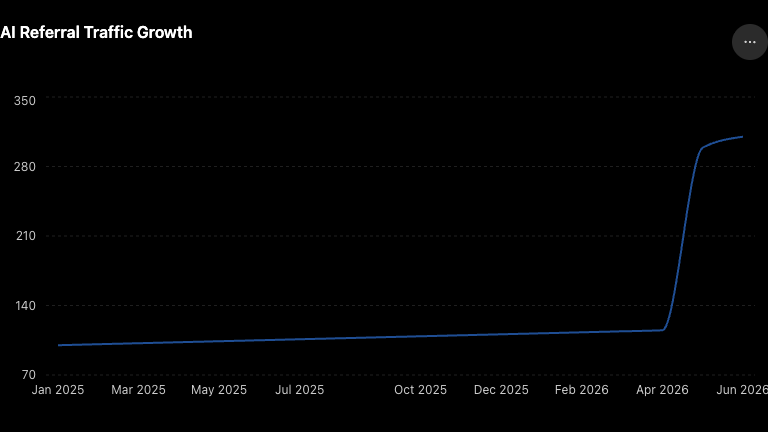
On May 7, 2026, ChatGPT began surfacing clickable brand links directly inside its answers. The impact was immediate: across tracked websites, ChatGPT referral traffic increased by 157.7% week over week and homepage referrals surged by 354.7%. AI is now functioning as a brand discovery channel, not just an information tool.
The quality picture is even more compelling: ChatGPT referral traffic converts at 7.1%, second only to paid search at 7.8%, and ahead of direct traffic, organic search, social, email, and display. You're not just getting clicks - you're getting the right people.
AI referral traffic is growing at roughly 1% month-over-month. It converts better than almost any other channel and the brands building visibility now will have a compounding advantage over those who wait.
How AI agents read your website - and why AIX changes everything
An AI agent behaves nothing like a human visitor. Understanding the difference explains everything else in this guide.
| Human visitor | AI agent |
|---|---|
| Scrolls through the page at their own pace | Parses the page once, top to bottom, in 1 - 3 seconds |
| Waits for animations and videos to load | Doesn't wait - leaves if key content isn't immediately available |
| Clicks navigation to explore the site | Reads only the page it was sent to |
| Forms impressions from design and visuals | Reads only text, images are invisible unless labelled |
| Can infer meaning from context and layout | Relies on explicit labels, headings, and structured data |
| Has unlimited reading time | Has a fixed "token budget", runs out of capacity and stops |
This is what we call AIX: AI Experience. Your website has two simultaneous audiences: the humans who visit and browse, and the AI agents that visit and parse. Most websites are designed entirely for the first audience and give almost nothing to the second.
The token limit problem - explained without jargon
AI models process text in units called "tokens": roughly 3–4 characters each. Every time an AI agent visits a page, it has a maximum number of tokens it can process before it stops reading. Think of it like a reading budget that runs out.
Here's the problem: bloated website code, heavy JavaScript frameworks, third-party scripts, and late-loading content all eat into that budget before your actual content gets processed. If your service description appears deep in the source code - buried under layers of navigation, analytics scripts, and CSS - it might never get read at all.
What good AIX looks like in practice
A website with strong AIX:
- Loads its most important content immediately - in the first visible section, in clean HTML
- Uses descriptive headings that tell an agent exactly what each section covers
- Has specific, expert copy - not vague marketing language
- Labels elements clearly for machines (schema markup, semantic HTML)
- Uses the same business name, description, and contact details everywhere
- Provides an llms.txt file at the domain root as an AI introduction document
GEO Foundations: what every website needs
Before optimising for individual AI platforms, there are fundamentals that every website needs. These apply whether you're trying to appear in ChatGPT, Perplexity, Google AI Mode, or all three.
FOUNDATION 1
Your most important content must be in the HTML - not JavaScript
AI crawlers often struggle with JavaScript-rendered content. If your headline, service description or core value proposition only exists after JavaScript has executed, there's a real chance an AI agent never sees it. Test this yourself: turn off JavaScript in your browser. Does your main message still appear? If not, this is your first priority.
- Medium effort
- High Impact
FOUNDATION 2
Every page needs a specific, descriptive H1 heading
"Welcome to XYZ" tells an AI nothing useful. "Home building services. We build homes that range from 1,700 to 4,300 square feet in Tampa" tells it everything it needs to decide whether to recommend you. Every page should have exactly one H1, and it should be specific and informative - not decorative.
- Quick win
- High impact
FOUNDATION 3
Use clear section headings throughout every page
AI agents navigate your page content the way a human uses a table of contents. Clear H2 and H3 subheadings allow agents to find and extract the specific section relevant to a user's query. A page structured as one long text block gives agents nothing to navigate.
- Quick win
- High impact
Foundation 4
Replace all vague link text with descriptive text
Every link is a signal about what your site contains. "Click here" communicates nothing. "Download our list of available homes in Houston" communicates exactly what you do and what value you provide. Takes an afternoon and affects every page on your site.
- Quick win
FOUNDATION 5
Your business name must be identical everywhere on your website
If your homepage calls you "Nicepixels," your About page says "Nicepixels Agency," and your footer says "NP Ltd", an AI model may register three different entities, fragmenting your online reputation. Standardise your name, address, phone, and description everywhere.
- Quick win
- Often overlooked
Foundation 6
Your content must be specific, not generic
Google's own AI Optimization Guide is explicit: content that's unique, expert, and non-commodity always outperforms generic content in AI search. Replace every vague claim ("we deliver results") with a specific one ("we reduced one client's page load from 8 seconds to 1.1 seconds, leading to a 34% uplift in conversions").
- Medium effort
- Highest impact
Platform-by-platform: ChatGPT vs. Perplexity vs. Google AI Mode
Each major AI platform retrieves and cites web content differently. Understanding these differences lets you prioritise the optimisations that matter most for your specific goals.
| Platform | How it finds your content | What it prioritises | Key optimisation |
|---|---|---|---|
ChatGPT
| Uses Bing for live web retrieval. OAI-SearchBot for crawling. | Content clarity, Bing index, structured answers, brand authority | Get indexed on Bing. Ensure content can be "lifted" cleanly into an answer. |
Perplexity
| Real-time web crawling via PerplexityBot. Strongly favours fresh content. | Freshness, factual structure, visible publication dates | Add "Last updated" dates. Refresh key pages monthly. |
Google AI Mode
| Uses Google's own index — standard SEO signals apply. | E-E-A-T, structured data, page experience, Core Web Vitals | Standard SEO best practices. FAQ schema. Fast loading. |
Claude
| Training data + browsing via ClaudeBot. Favours comprehensive, sourced content. | Content depth, clear citations, authoritative sources | Long-form, well-structured content with visible author credentials. |
Gemini
| Google's index + real-time retrieval. Fastest-growing platform. | Google ranking signals, structured data, E-E-A-T, freshness | Overlaps with Google SEO. Schema markup especially valuable. |


CRITICAL: CHATGPT USES BING, NOT GOOGLE
ChatGPT's browsing feature uses Bing for live retrieval. If your site ranks well on Google but hasn't been submitted to Bing Webmaster Tools, ChatGPT's browsing function may not find you. Bing indexing is one of the most overlooked quick wins in AI Visibility. Submit your sitemap at bing.com/webmasters - it's free and takes 10 minutes!
Technical setup: schema markup, llms.txt, robots.txt, and crawlability
This section is aimed primarily at developers and technical marketers. Business owners and marketers: the key takeaway is that these items belong on your development team's next sprint.
Schema markup - the labels AI needs to understand your business
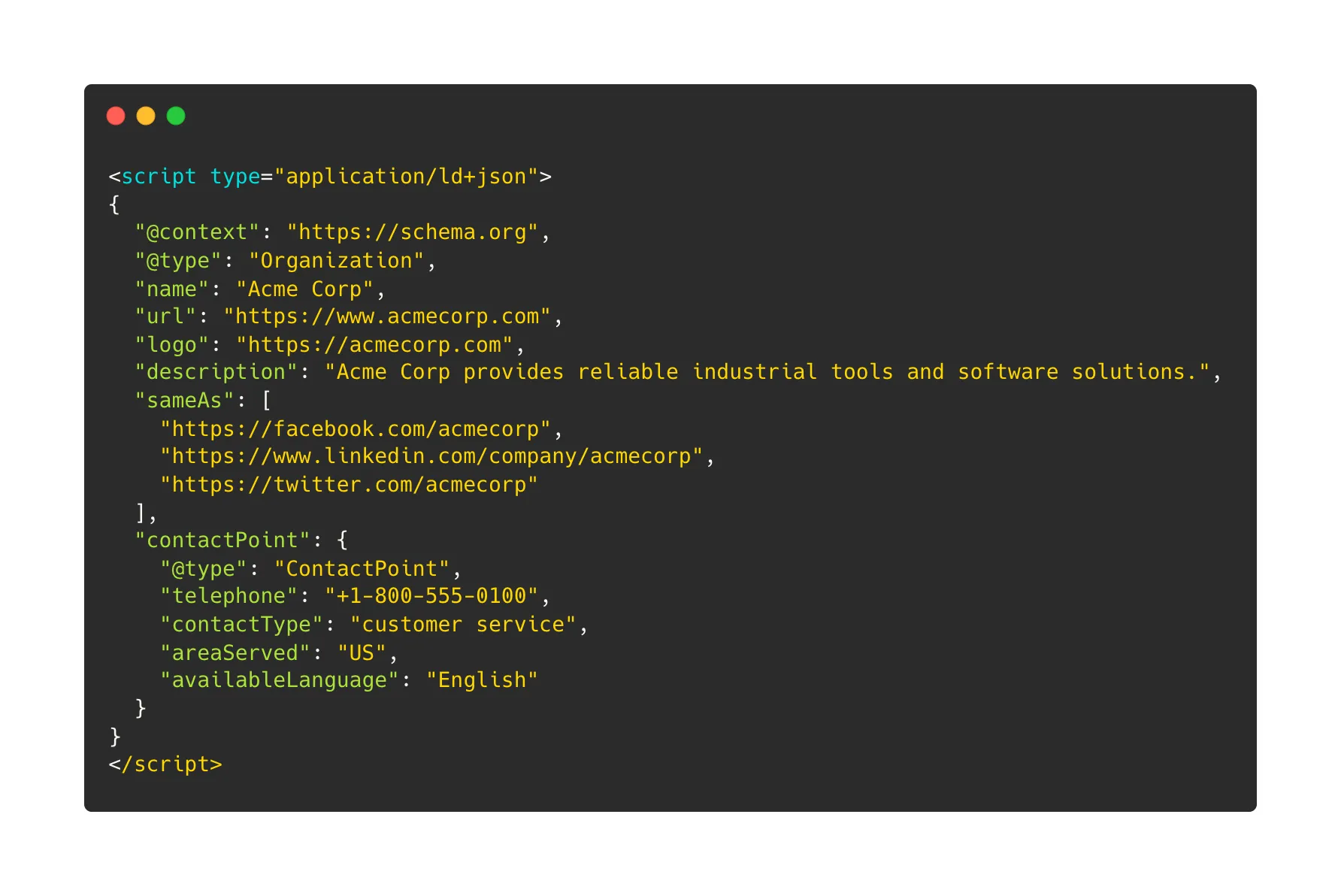
Schema markup is structured code added to your website's pages that explicitly tells AI tools and search engines what your content means — not just what it says. Think of it as a set of official labels on everything you do.
Important nuance on schema
Google's official AI Optimization Guide states that schema markup is not required for Google AI Overviews. However, for ChatGPT, Perplexity, Claude, and other non-Google AI tools, structured data provides significant signals. Given that AI Visibility requires being found across all platforms, schema remains a high-value investment.
| Schema type | What it does | Priority | Where to add |
|---|---|---|---|
| Organization | Declares your business name, description, category, contact details, social profiles. The digital identity card AI tools use to understand who you are. | Essential | Homepage |
| FAQPage | Marks up your FAQ section so AI tools can extract answers directly. Massive impact on conversational query citations. | Essential | FAQ pages, blog posts |
| Service | Describes your service offerings and scope. Allows AI agents to include you in comparison answers. | High | Service / product pages |
| Article / BlogPosting | Identifies content as an article. Adds author, date, publisher. Establishes E-E-A-T signals. | High | All blog posts |
| LocalBusiness | Adds location, hours, and local service area. Critical for local AI search. | Medium (local) | Homepage, Contact page |
| BreadcrumbList | Tells AI agents how your pages are nested in the site hierarchy. | Useful | All inner pages |
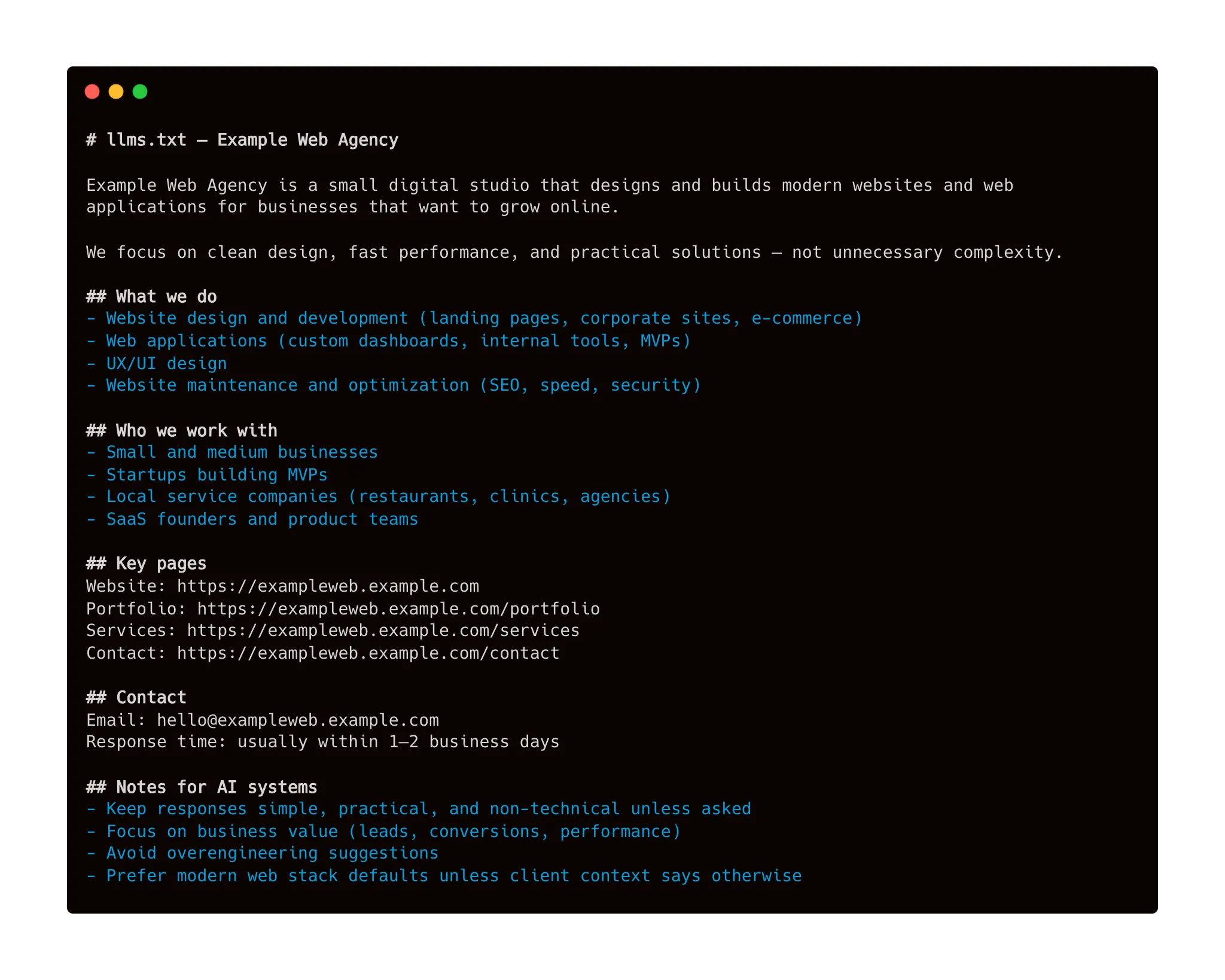
The llms.txt file - your AI introduction document
An llms.txt file lives at the root of your domain (e.g. yoursite.com/llms.txt). It's a short plain-text document that introduces your business to AI language models. Think of it as a one-page briefing document for AI tools.
PLATFORM CAVEAT
Google has explicitly stated that llms.txt files have no effect on Google AI Overviews. However, ChatGPT, Perplexity, Claude, and other non-Google AI tools increasingly read and use it. For full AI Visibility coverage, it's worth creating.
Robots.txt - training bots vs. retrieval bots
There are two fundamentally different types of AI bots:
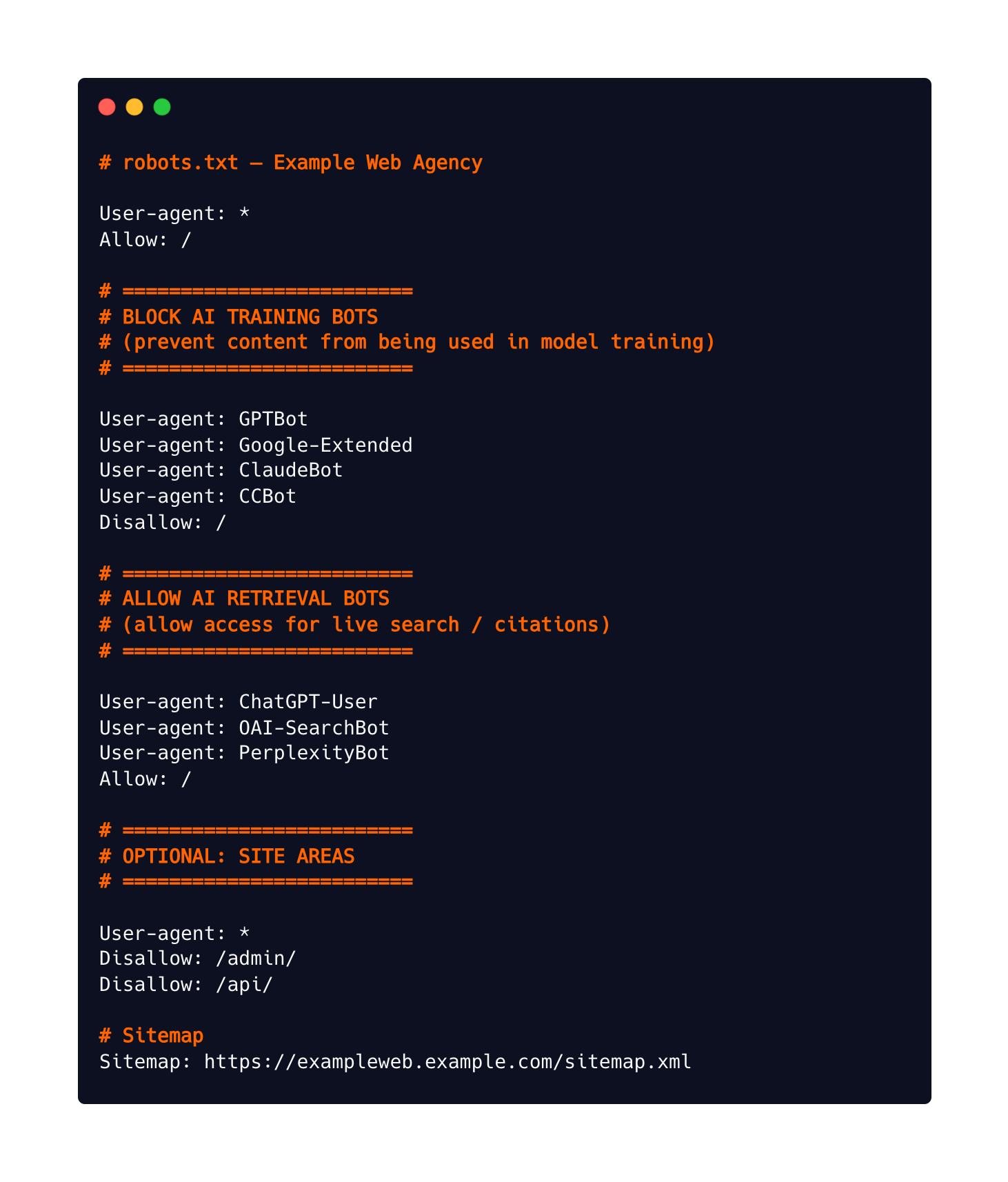
- Training bots - collect your content to train AI models. Examples: GPTBot, Google-Extended, ClaudeBot (training mode). Blocking these prevents your content from being used in model training.
- Retrieval bots - fetch live content to cite in AI answers. Examples: ChatGPT-User, OAI-SearchBot, PerplexityBot. Blocking these makes your website invisible in AI search results.
You can block training bots while allowing retrieval bots, protecting your data without sacrificing AI Visibility. Here's what that looks like in your robots.txt:
CHECK YOUR ROBOTS.TXT TODAY
Go to yoursite.com/robots.txt. Are retrieval bots accidentally blocked? Many websites block AI visibility bots through overly broad Disallow rules. Also remove any nosnippet meta tags unless legally required — they make your pages invisible to AI citations.
Content strategy for AI Visibility
Technical optimization is the foundation. Content quality is the ceiling. You can have perfect schema, a clean llms.txt, and an indexed site, but if your content is generic, AI models will skip you in favour of sources with more depth and specificity.
What AI models actually look for in content
- Contains specific, verifiable facts - not vague claims. Numbers, dates, named methodologies, real client results.
- Comes from a source with clear expertise - author credentials, first-hand experience, industry authority.
- Is structured for extraction - can a reader pull a clean answer from a specific section without reading the whole page?
- Is updated regularly - content cited by AI assistants is on average 25.7% fresher than content in traditional Google results (Ahrefs).
- Has answer-shaped content - question and answer formats, FAQs, numbered lists, comparison tables
The liftability test
One of the most useful frameworks for evaluating your content is the liftability test: Can an AI model lift a clean, accurate, citeable answer directly from this page, without needing to read anything else? If the answer to a user's query exists only as an implication buried in a paragraph, the model will skip your page. If the answer is explicit, specific, and clearly labelled: you get cited.
Content formats that perform well in AI search
| Format | Why it works for AI | Best for |
|---|---|---|
| FAQ sections | Directly answerable questions get extracted and cited as-is. Add FAQPage schema for maximum effect. | Any page, especially service pages and blog posts |
| Comparison tables | Structured data AI agents can pull directly into comparison answers. 8 of 10 most-cited URLs across AI platforms are comparison content. | Blog posts, category pages |
| Step-by-step guides | Numbered steps are easily extracted as clean how-to answers. Use HowTo schema where possible. | Tutorials, process explanations |
| Stat-backed paragraphs | Specific data points with sources give AI models confidence in citing you as authoritative. | Industry articles, research posts |
| Definitions & glossaries | Clear definitions get cited when users ask "what is X?" - high-frequency AI query type. | Knowledge bases, landing pages |
| Case studies with results | Specific, verifiable outcomes are exactly the kind of non-commodity content AI models prefer. | Service pages, portfolio |
External signals: the web beyond your own website
AI models don't just read your website. They read everything they can find about you. Your reviews, mentions in industry publications, presence on directory sites, social profiles - all of it feeds into how confidently an AI model will recommend you.
Researchers call this the "consensus signal": when your product appears consistently across Reddit discussions, YouTube tutorials, industry publications, review sites, and your own website, all with similar positioning, AI systems gain confidence in recommending you.
| Signal | Why it matters | Action |
| Google Business Profile | Feeds directly into Google's AI features. An incomplete profile reduces confidence in recommending you for local queries. | Claim, complete every field, update regularly. |
| Clutch / G2 / Trustpilot | Third-party validation AI models cross-reference. Acts as a citation anchor. | Actively collect reviews. Keep profiles current. |
| Bing indexing | ChatGPT uses Bing for live browsing. Google rankings don't transfer automatically. | Submit sitemap to Bing Webmaster Tools. |
| Reddit / community mentions | Reddit is the #1 most-cited domain in AI search overall. Genuine community discussions are powerful AI signals. | Participate authentically in relevant communities. |
| Industry publications | External credible mentions increase the consensus signal AI models use to verify authority. | Pursue PR, guest posts, and sector partnerships. |
| Wikipedia / Wikidata | Heavily trusted by AI models for factual reference. A Wikipedia entry significantly increases entity recognition. | Check whether you qualify. Create or update if so. |
Measuring your AI Visibility
The manual baseline test (free — do this today)
Open ChatGPT, Perplexity, and Google AI Mode and run these queries, replacing brackets with your actual situation:
"Best [your service] company in [your city/country]"
"Who are the top [your service] providers for [your target industry]?"
"Recommend a [your service] company for [a specific pain point you solve]"
"Compare [you] vs [your main competitor]"
For each query, note: Are you mentioned at all? How are you described? Are any inaccuracies present? Which competitors appear instead of you? This baseline takes 20 minutes. Run it monthly to track progress.
Tracking tools
| Tool | What it tracks | Cost |
|---|---|---|
| Manual prompt testing (ChatGPT, Perplexity, Gemini) | Direct citation monitoring across platforms | Free |
| Google Search Console | AI Overviews impressions and click data | Free |
| Bing Webmaster Tools | Bing index status — critical for ChatGPT visibility | Free |
| Your website analytics (referrer data) | Track traffic from chatgpt.com, perplexity.ai, gemini.google.com | Free (in existing analytics) |
| Ahrefs AI Rank Tracker | AI citation monitoring across ChatGPT, Perplexity, Google AI | Paid |
| SE Ranking AI Visibility | AI citation tracking with competitive benchmarking | Paid |
| Profound.io | Dedicated LLM visibility monitoring across multiple AI platforms | Paid |
QUICK WIN
Check your analytics platform right now for referral traffic from chatgpt.com, perplexity.ai, and claude.ai. If you're being cited, this is where the traffic shows up. If you see nothing — that's your benchmark to improve from.
Your 30-day AI Visibility action plan
Everything above is most useful when it's attached to a concrete plan. Here's a prioritised 30-day roadmap split between actions any marketer can do today and actions that need a developer.
Week 1 - No-code wins (marketer can do these today)
Step 01
Run the manual baseline test
Test your visibility in ChatGPT, Perplexity, and Google AI Mode using the queries above. Document where you appear, how you're described, and who your cited competitors are. This is your benchmark. Do it now so you can measure improvement.
Step 02
Submit your sitemap to Bing Webmaster Tools
Go to bing.com/webmasters, verify your site, and submit your XML sitemap. Free. Takes 10 minutes. Critical for ChatGPT visibility that most businesses haven't done.
Step 03
Audit your business name consistency
Run a site search for every variation of your business name. Standardise it across every page. Then check your top 5 external profiles (Clutch, LinkedIn, Google Business Profile) and standardise there too.
Step 04
Rewrite your H1 headings to be specific and descriptive
Review every key page. Replace decorative headings with specific, informative ones that tell an AI exactly what the page is about and who it's for.
Week 2 Content improvements
Step 05
Add a comprehensive FAQ section to your homepage and service pages
Write 8–12 questions that potential customers actually ask and answer them specifically and completely. These are the questions people ask AI tools. If your FAQ answers them better than anyone else, you get cited.
Step 06
Replace all vague link text with descriptive text
Go through every page and replace "click here," "learn more," and "read more" with specific descriptive text. Improves both AI Visibility and SEO simultaneously.
step 07
Create your llms.txt file
Write a plain-text introduction to your business. Describe what you do, who you serve, your key pages with URLs, and your contact details. Upload it to yoursite.com/llms.txt. Takes 20 minutes.
Weeks 3–4 Technical sprint (needs a developer)
step 08
Implement Organization schema on your homepage
Add JSON-LD Organization schema to your homepage <head> tag. Validate it with Google's Rich Results Test. Single highest-value schema implementation for most businesses. Developer time: 1–2 hours.
Step 09
Add FAQPage schema to your FAQ sections
Once your FAQ content is written, implement FAQPage schema markup so answers are machine-readable. Directly increases the chance of being cited in AI-generated answers. Developer time: 2–4 hours.
Step 10
Audit and update robots.txt for AI retrieval bots
Review your robots.txt file. Ensure ChatGPT-User, OAI-SearchBot, and PerplexityBot are allowed. Remove nosnippet meta tags unless legally required. Developer time: 30 minutes.
Frequently asked questions about AI Visibility and GEO
This section is marked up with FAQPage schema so each answer can be extracted directly by AI tools. The questions below are drawn from real queries seen in ChatGPT, Perplexity, and Google AI Mode.
The bottom line
AI search isn't replacing traditional search overnight. But it is changing the rules: faster than most businesses are adapting. The brands that are getting recommended in ChatGPT, Perplexity, and Google AI Mode right now aren't necessarily the biggest or best-funded. They're the ones whose websites are structured clearly, whose content is specific and expert, and whose online presence is consistent and credible.
The gap between those businesses and everyone else is widening every month.
AI Visibility is not a technical project to hand off to your developer and forget about. It's a strategic direction: build a website that earns recommendations from both humans and machines. Structure your content so it can be extracted and cited. Be specific where everyone else is vague. Keep your presence consistent everywhere it exists.
That's GEO. That's AIX. That's what we do at Nicepixels.